 ®
®Flying Monkeys and the Smear Campaign: Recognizing the Architecture of Narcissistic Abuse
By the time the abuse becomes undeniable, the people around you have often already been quietly recruited to doubt you. Understanding how this happens is one of the most stabilizing things a client can learn.
Flying Monkeys and the Smear Campaign: Recognizing the Architecture of Narcissistic Abuse
A client tells me, early in our work together, that no one believes her. Not fully. Her friends have started giving her a certain look when she brings up her ex-partner — polite, careful, a little too neutral. Her sister has started taking his side on small things, things her sister wasn't even present for. A mutual friend she barely knows sent her a message weeks ago, out of nowhere, defending him, telling her she was "being dramatic" and needed to "let it go."
She hasn't done anything to provoke this wave of doubt. That's precisely the point. It was built before she ever knew it was under construction.
This is one of the more disorienting features of relationships with individuals who show high narcissistic traits: by the time the abuse becomes undeniable to the person living inside it, the people around them have often already been quietly recruited to doubt them. Understanding how this happens — and why it happens on a predictable timeline — is often one of the most stabilizing things a client can learn in treatment.
The Cycle: Idealize, Devalue, Discard
Relational patterns involving high narcissistic traits — whether or not the partner, parent, or family member meets full diagnostic criteria for Narcissistic Personality Disorder — tend to move through a recognizable arc. Idealization comes first: intense attention, flattery, a sense of being chosen and exceptional. Devaluation follows, often gradually enough that the person on the receiving end adjusts their sense of normal in real time rather than noticing the shift. Criticism increases. Warmth becomes conditional and unpredictable. The person begins to feel that they are somehow responsible for the coldness, and works harder to earn back what they had at the start.
The third phase — discard — is where many clients first come into treatment. But clinically, it's worth working backward from the discard to something that usually precedes it: the smear campaign.
The Pre-Emptive Smear Campaign
A smear campaign, in this context, is a coordinated effort — sometimes explicit and deliberate, sometimes nearly unconscious on the part of the person doing it — to damage someone's credibility and relationships before the abuse escalates further, and especially before a discard. This ordering matters. It is not a reaction to being exposed. It is preparation for exposure that hasn't happened yet.
The function is protective, from the abusive individual's perspective, and preemptive in the most literal clinical sense: it inoculates their social environment against whatever the victim might eventually say. If the people around the couple, the family, or the workplace have already been primed to see the victim as unstable, dramatic, vindictive, or "not quite remembering things right," then anything the victim later discloses — even calmly, even with evidence — arrives pre-discredited. The groundwork is laid while the relationship still looks, from the outside, entirely intact.
Clinically, this is worth naming explicitly with clients, because the timeline confuses people. Many clients assume that if others are doubting them, they must have actually done something to deserve it. Understanding that a smear campaign is frequently seeded in advance of any real conflict, as a strategic move rather than a reactive one, helps clients stop searching their own conduct for an explanation that isn't there.
Flying Monkeys
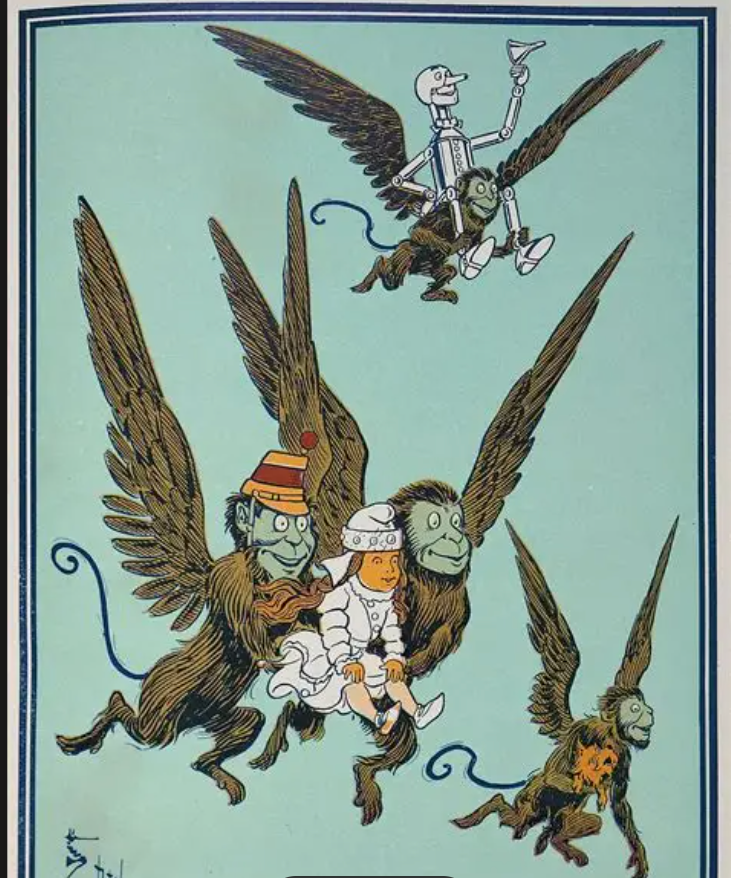
The term "flying monkeys" — borrowed from The Wizard of Oz, where the Wicked Witch dispatches winged monkeys to do her bidding without ever appearing herself — has become widely used in both clinical and popular literature on narcissistic abuse to describe third parties who are recruited, knowingly or not, to extend the abusive individual's reach.
Flying monkeys take several forms. Some are willing participants who genuinely side with the abusive person. Others are unwitting — a well-meaning mutual friend, a family member, a coworker who has simply absorbed the narrative they were given and is repeating it in good faith. A smaller number are recruited more deliberately, given specific talking points, specific incidents to bring up, specific doubts to plant.
What unites all three types, clinically, is function rather than intent: they carry the smear campaign into spaces the abusive individual cannot personally reach, and they do it with a credibility the abusive person themselves has already spent.
This is often the part that lands hardest in session. Clients can brace themselves for cruelty from the person who has already hurt them. They are rarely braced for it to arrive through a sibling, a childhood friend, or a coworker who has no obvious stake in the conflict at all.
Recognizing It in Real Time: The Anatomy of a Coordinated Campaign
Synchronized timing is a diagnostic clue. Organic concern accumulates slowly and unevenly. Coordinated campaigns cluster — multiple posts, from multiple accounts, within minutes of each other. The timestamps tell the story.
Neutral facts get hijacked into the existing narrative. An ordinary, defensible decision gets reframed as evidence of wrongdoing. A fact doesn't need to be damning to be used — it only needs to be available.
The network gets recruited, not just individuals. A claim from an ex-partner reads as biased. The identical claim from an apparently neutral third party reads as corroboration — even when their only source is the same ex-partner.
Private health information becomes a weapon. Mental health stigma does most of the campaign's work; the audience doesn't need to evaluate whether the claim is true.
Campaigns cluster around major transitions. A divorce, a business restructuring — moments when a target's credibility reserves are already under strain are when a competing narrative is easiest to plant.
Removal is rarely the end — reactivation often follows. A common next phase is a different messenger reviving the same claims after the first version gets taken down.
What This Means Clinically
None of this is conspiracy thinking — paranoia sees coordination everywhere, including where it doesn't exist. Recognizing an actual documented pattern is pattern recognition, checkable against evidence.
This externalizes what's often deeply internalized, helps clients calibrate realistic expectations of third parties, and — most importantly — helps clients understand they were never going to be believed easily, regardless of their own conduct.
A Note on Diagnosis and Language
Most people who engage in these patterns have not been formally diagnosed with Narcissistic Personality Disorder. "High narcissistic traits" does real clinical work here precisely because it describes a pattern without overstating a diagnostic claim about someone never assessed.
The scenarios and patterns described in this piece are illustrative composites drawn from recognized clinical literature and general practice patterns. They are not accounts of any specific client, individual, or incident.
Explore Topics
Written by
Mx. Love C. Dialogos, LMFT
Content creator and writer sharing insights and stories.
© 2026 Love Psychotherapy, LLC. All rights reserved. Love Psychotherapy® is a registered trademark.